The Hatuniye Complex—Bayezid II’s Gift to His Mother in the Heart of Tokat
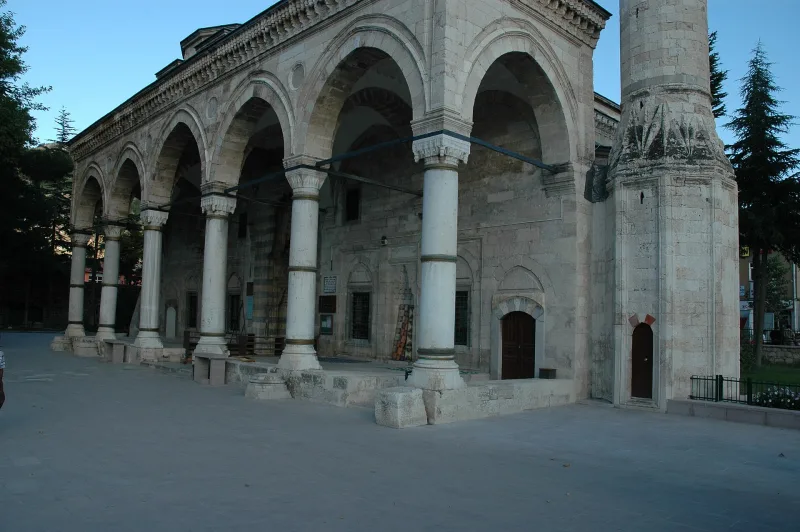
In the center of the provincial city of Tokat, on Meydan Square, stands an architectural complex with a personal history behind it: The Hatuniye Complex (Hatuniye Külliyesi, Hatuniye Camii) was built by order of the Ottoman Sultan Bayezid II in 1485 in honor of his mother, Gülbahar Hatun. A külliye—an Islamic religious complex comprising a mosque, an imaret (charity kitchen), and a madrasa—was one of the tools the Ottomans used to transform conquered lands into thriving cities. The Hatuniye Complex is one of the finest examples of this practice in Tokat: hewn-stone walls, a portal with Seljuk-style stalactites, and carved wooden doors in the künde-kari technique. Today, the mosque is active, the madrasa is open to visitors, and the entire complex is considered the city’s most beautiful Ottoman monument.
History and Origin of the Hatuniye Complex
Gülbahar Hatun—the mother of Bayezid II—whose memory is immortalized in the name of this complex. “Hatuniye” literally means “female” or “mother”; this is a long-standing Ottoman tradition: building külliyes in honor of the mothers and wives of ruling figures. Just as Istanbul has the Valide Mosque, it was decided to erect a monument to Gülbahar Hatun in Tokat—one worthy of her status and piety. Construction was completed in 1485, and since then the complex has borne the name of the sultan’s mother.
In the 15th century, Tokat was an important administrative center of Anatolia, situated on the trade route from Constantinople to Persia. The city already had several Seljuk and early Ottoman structures, and the new külliye blended into the existing urban landscape—yet stood out for its scale and quality of craftsmanship. Bayezid II is known as a ruler with refined artistic taste: much was built throughout the Ottoman Empire during his reign, and the Tokat complex is evidence of this policy of monumental construction on the periphery.
The külliye consisted of a mosque, an imaret, and a madrasa. An imaret in an Ottoman urban complex was not merely a kitchen: it was an institution for distributing free food to the poor, travelers, and madrasa students. A madrasa was an educational institution where Islamic law and theology were taught. This entire triad created a vibrant social infrastructure around the mosque, which drew people in and strengthened the residents’ ties to the Ottoman authorities. Today, the imaret is no longer in operation, but the madrasa is open to visitors, and the mosque functions as an active house of worship.
Architecture and What to See
Hatuniye Camii is a complete architectural entity in which every element carries meaning. The building is constructed of hewn limestone, while the drum dome above the central hall is built of brick—a characteristic division of materials typical of 15th-century Anatolian Ottoman architecture.
Portal and wooden doors
The main entrance is adorned with a Seljuk-style marble portal featuring deep muqarnas (stalactites). This decorative form was introduced into Ottoman architecture from Seljuk madrasas and mosques; Tokat, situated along the path of Seljuk influence, preserved this tradition until the late 15th century. Above the wooden doors, crafted using the künde-kari technique—"woven wood," a geometric ornament made of wooden strips joined without glue—is an Arabic hadith inscription set in a yellow-and-black marble frame. The inscription reads: “Hasten to prayer before time runs out, and to repentance before death comes”—an admonition addressed to everyone who enters.
The Main Hall and the Dome System
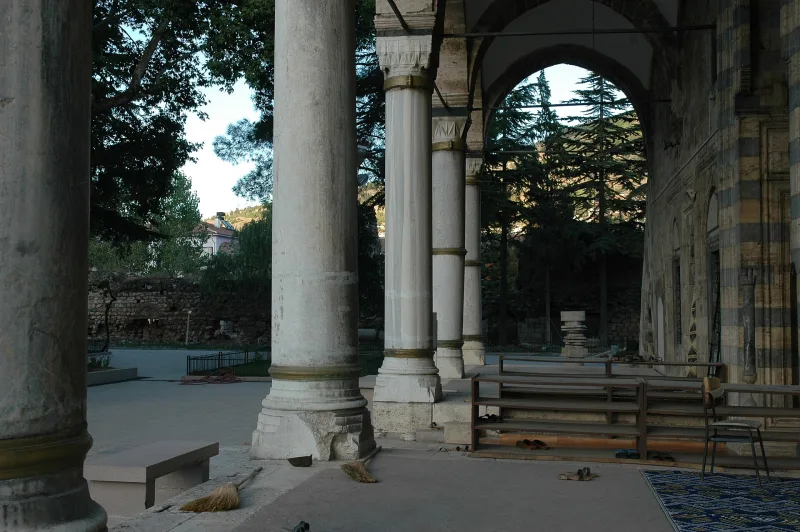
The central space of the mosque is square in plan; the dome above it rests on a twelve-sided drum. On either side of the central hall are two additional square rooms, each with its own dome supported by prismatic transitional elements—pendentives. In front of the entrance is the five-domed son jamaat eri (a portico for the rear rows of worshippers), supported by six columns. The walls are pierced by three rows of double windows: they let generous daylight into the hall, which lends the white stone and plaster a special purity. On the north wall above the entrance is the muezzin mahfil—a closed box for the muezzin.
Mihrab, Minbar, and Kallim-i-Shleri
The mihrab is made of marble in the shape of a half-cylinder with columns on either side; it is decorated with relief ornamentation. Unfortunately, the wooden minbar was covered with oil paint during one of the renovations and lost the original beauty of the wood. The walls still feature the original kallim-ishleri—decorative ink paintings applied with a brush, typical of Ottoman interiors from the late 15th to early 16th centuries.
Minaret and Shadiran
A minaret adjoins the northwest corner of the mosque: its octagonal base transitions into a polygonal shaft with a single sherefe (balcony). In the courtyard stands an original wooden shadirvan—a fountain for ritual ablutions before prayer. It has an octagonal shape with eight sections, covered by a tiled roof with pointed conical ends; the shadirvan was built later than the main building and is considered not an original but a customary element of the complex.
Interesting Facts and Legends
- The complex was built “in honor of the mother” of the ruling sultan—this was a long-standing Ottoman tradition; similar structures exist in Istanbul (Valide Mosque), Bursa, and other cities.
- The inscription on the marble frame above the entrance doors contains a hadith on prayer and repentance; the same text is inscribed in several places throughout the interior: on the doors, in the window jambs, and next to the mihrab—as a constant reminder to worshippers.
- The mosque’s wooden doors are crafted using the kundekâri technique: a geometric ornamentation made of wooden strips joined without glue or nails—a form of Islamic decorative and applied art requiring the highest precision from the carpenter.
- The original wall paintings (kallam-işleri) have been preserved inside the mosque; these are among the few intact examples of such 15th-century ornamentation in the entire Black Sea region.
- Construction was completed in 1485—precisely at a time when Bayezid II was actively building throughout Anatolia, seeking to consolidate Ottoman power in the cities through architectural gestures that evoked the memory of ancestors.
How to get there
Tokat is located in the Black Sea region of Turkey, approximately 105 km southwest of Samsun and 200 km north of Sivas. The nearest airport is Tokat Yıldız (TJK), which is served by domestic flights from Istanbul and Ankara. It takes about 10 minutes by taxi from the airport to the city center. An alternative option is Samsun Çarşamba Airport (SZF), which offers a wider selection of flights and a bus ride to Tokat of about 1.5 hours.
Hatuniye Camii is located in the Meydan district in the very center of Tokat, right next to the main city square. It is about a 20-minute walk from the bus station (otogar). From any central point in the city, it is a 5–10-minute walk to the mosque. Landmarks include Meydan Meydanı Square and the Tokat Clock Tower. The mosque is open daily; tourists may visit between prayer times. The madrasa within the complex is open for self-guided tours.
Tips for travelers
Standard rules for mosques in Turkey apply when visiting Hatuniye Camii: remove shoes at the entrance, cover shoulders and knees, and women must wear a headscarf. Headscarves are usually provided at the entrance free of charge. The best time to explore the interior is in the morning on weekdays, when there are no prayers and few visitors. At this time, the hall is bathed in a calm, dim light, pierced by streaks of sunlight through the double windows—an atmosphere that perfectly captures the spirit of the Ottoman prayer space.
It takes 40–60 minutes to tour the mosque itself, the portal, and the courtyard. The madrasa takes another 20–30 minutes to explore. Tokat is a small and cozy city where the main attractions are concentrated in the historic center. Near Hatuniye Camii are: the Tokat Museum, the Garibdede Mosque, the Atatürk House, and the Gök Medrese. You can walk to all these sites in a single morning without needing public transportation.
Tokat is known for its grapes and shawl weaving—traditional crafts of the region. At the local market, be sure to buy some dried grapes and try Tokat kebab (Tokat kebabı)—a dish with a reputation as a regional favorite. The city offers several cozy family-run hotels. The Hatuniye Complex is a monument where the architectural precision of the 15th century coexists with the vibrant religious rhythm of the 21st; come with an open mind, and you’ll see both layers at once.